Litigation Intelligence
The research memo — grounded in authority, drafted in minutes.
Smriti searches by legal principle, not keyword. Every result traces to a decided case or enacted statute. Every draft cites its sources.
Smriti is a semantic legal research and AI drafting platform that indexes apex and appellate court judgments across Indian jurisdictions, enabling legal professionals to find relevant case law by legal principle rather than keyword and save 8–12 hours per research cycle.
Capabilities
Smriti Capabilities
Semantic Search
Finds similar legal principles, not keywords. Query by concept, legal issue, or factual pattern — retrieve relevant judgments across jurisdictions.
Case Law Indexing
Apex and appellate court judgments indexed across jurisdictions. Landmark decisions and recent rulings organized by legal principle and subject matter.
AI Drafting
Research-backed draft arguments grounded in identified case law and statute. Every passage traces to a specific judgment or enacted provision.
Statute Identification
Applicable statutory provisions identified alongside relevant case law. Statute sections cross-referenced with judicial interpretation from reported decisions.
Architecture
Research grounded in primary authority.
Not approximations. Not summaries. Sources.
Most legal research tools index documents. Smriti indexes legal authority — the statutes, the judgments, the interpretive logic that connects them. Built from primary sources, jurisdiction by jurisdiction.
The knowledge graph expands continuously. The standard never changes: every result traces to a decided case or enacted statute. No generated citations. No hallucinated precedent.
This is not localization. This is origin.
How it works
How Smriti Works
Step 01
State the legal question.
Describe the issue in the language you'd use with a colleague. Smriti identifies the relevant statutes, precedents, and legal principles — across jurisdictions, across courts, across decades of reported decisions.
Step 02
Review cited authorities.
Every result traces to a specific decided case or enacted statute. Ranked by semantic relevance to the legal question — not by keyword frequency. The distinction matters: keyword search finds documents that mention your terms. Semantic search finds decisions that address your issue.
Step 03
Draft with grounding.
Generate argument drafts where every claim is anchored in a cited authority. No assertion without attribution. No precedent without a citation. The kind of grounded drafting that a senior associate produces — generated as a starting point, not a final product.
Product Demo
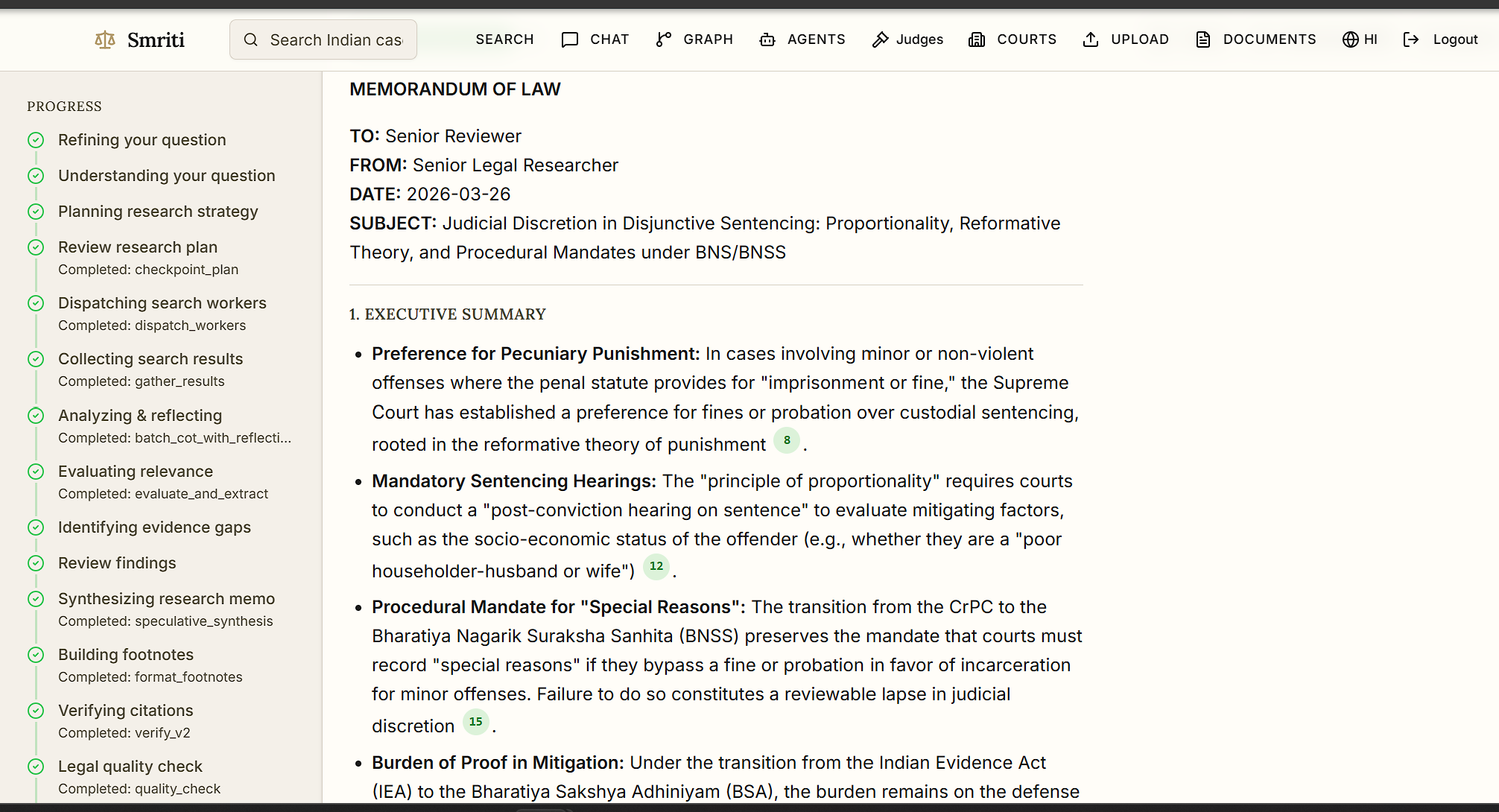
8–12 hrs
saved per case research
A comprehensive case research memo that takes a full working day. Smriti delivers the first draft with cited authorities in minutes.
FAQ
Frequently Asked Questions
What case law does Smriti cover?
Smriti indexes reported decisions from apex and appellate courts across jurisdictions. Coverage spans landmark decisions, recent rulings, and the full depth of case law relevant to commercial, civil, and regulatory practice. The knowledge graph expands continuously.
How does semantic search differ from keyword search?
Keyword search matches exact terms. Semantic search identifies legal principles, reasoning patterns, and conceptual similarity across judgments. A query about 'breach of fiduciary duty' surfaces relevant decisions even when that exact phrase does not appear in the judgment text.
Can Smriti draft legal arguments?
Smriti generates draft arguments grounded in identified case law and statute. Every drafted passage traces to a specific judgment or enacted provision. The output is a research-backed starting point, not a final product.
Which statutes does Smriti cover?
Smriti covers enacted statutes across commercial, corporate, regulatory, and civil domains. The system ingests primary statutory sources jurisdiction by jurisdiction and cross-references them with judicial interpretation from reported decisions. Coverage expands continuously across jurisdictions and practice areas.
How does Smriti handle statute identification?
When researching a legal issue, Smriti identifies applicable statutory provisions alongside relevant case law. Statute sections are cross-referenced with judicial interpretation from reported decisions.
How much time does Smriti save on case research?
Legal teams report saving 8–12 hours per case research cycle. Research that previously required manual review of multiple databases and physical reporters is completed in a fraction of the time.
How does Smriti protect research data?
Research queries are not used for model training. All data stays within the engagement boundary. Privacy is architecture, not policy — built into the system from the ground up.